
CRATE LEARNING, WITHOUT THE COUNTDOWN
A place.
Not a deadline.
An open entrance. A person nearby. A chance to choose. Crate learning is more than getting a latch closed.
Explore Door & Distance ↗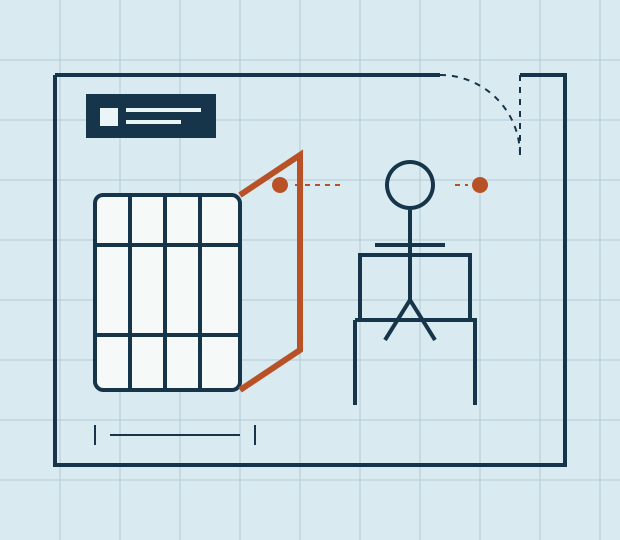
Two changes.
Different questions.
Closing the crate door changes access. Walking out changes company. Doing both at once does not tell you which part was difficult.
Our diagram keeps those concepts separate. It never tests your dog, sets a waiting time or declares a setup safe.
A FICTIONAL COMPARISON, NOT A TRAINING LADDER
Change the picture.
Keep the unknowns.
Four room diagrams. Three reading lenses. No animal inputs, readiness score or instruction to move to the hardest picture.
Open the comparison ↗EIGHT ROOM NOTES
Make room for the whole dog.
An open invitation, not a trap.
Start with a place a dog can approach and leave, rather than a door that closes as soon as food appears.
The door is a new question.
Voluntary entry and comfort behind a closed door are related, but they are not interchangeable.
Nearby is not the same as alone.
A person beside the crate and a person out of sight create different situations.
When worry changes the plan.
Do not make silence, a timer or a checklist the price of getting help.
Space, water and a way back.
A welcoming setup meets needs; it does not certify that confinement is appropriate.
More than one place to rest.
A pen, a gated room or supported company may be part of an alternative, not a training defeat.
A puppy's night is not a work shift.
Nighttime access, company and toilet needs are not settled by an age-to-hours formula.
Old associations, new conversations.
An adult dog or a difficult crate history deserves an individual starting point.
LATEST FROM ROOM NOTES
The chair that stayed
A fictional room rearrangement makes one change easier to name.
Read Room Notes ↗